
Mallorca
A love letter from our guest author
Rita-Graciela Werner to her island — discovered, as the best things often are, by circuitous routes.
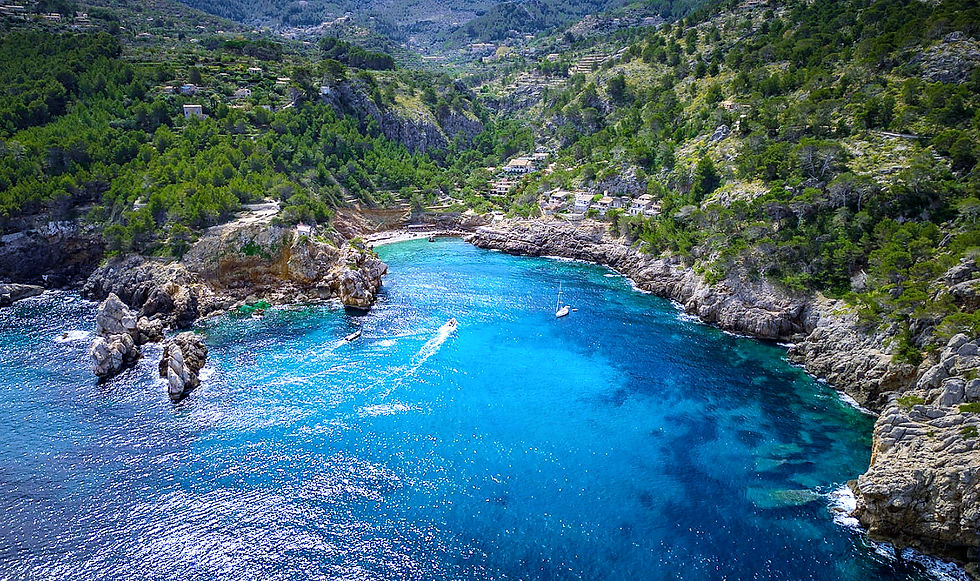
My Mallorca – a love letter to a mistake
Africa was the plan. Zebras, heat, red earth. I had mentally moved into a safari tent when, in 2004, a dream interrupted everything — arriving at midnight, landing squarely in the heart, settling on an island. It smelled of wild rosemary and shimmered in the midday heat.
In that dream, Mallorca had a sway to it — something so sensual that I woke up with what I can only describe as a sunburn on my soul, and thought: I need to see this. Africa would have to wait.
I booked a flight.


My new home-from-home sat conveniently close to a supermarket called Eroski. I'll admit, naïve and curious as I was, I had harboured vague hopes of finding something mildly provocative between the tinned peaches. Instead: house-brand tuna. Announcements in German — Minced meat on special today! — and a clientele in socks and sandals wearing T-shirts I'd rather not describe. In such moments, I reminded myself: You're only here temporarily. A line that worked like sunglasses — not protection against everything, but enough to take the edge off the glare.
As someone half-Spanish — mother from Barcelona, father from the German Harz — I came looking for the magic of the South, and for distance. From the relentless travel, from the perpetual glitter of my then-role as communications director of a diamond company, following years in television. Here, in the quieter southeast of the island, I could finally let my thoughts settle. Between palms, silence, and nothing that needed to be done. Before the next thing, naturally.
What I found instead was a vivid collision: reserved Mallorquins and German holidaymakers engaged in a loud, cheerful competition to see who could be least subtle. Every flight landed to a round of applause, as though we had collectively achieved something extraordinary.


I retreated to my mill. Cooked, laughed, read. Gave the market in Santanyí a wide berth — too many straw hats, too many invitations to WhatsApp groups I didn't need. But slowly, I found the real people. Above all, Susanna — a Mallorquina, an entrepreneur, a lifelong friend. She is the reason I'm still here twenty-one years later, now an official resident, with a Belgian husband, a dog, a cat, and something that feels like purpose.
Today we live in the centre of the island, in an old lime kiln. The cement oven is still standing. Our life? Something like Pippi Longstocking, but with Wi-Fi. This is where the real Mallorca lives — far from yacht-club glamour, but with its own honest concerns: flooding, power cuts, stubborn winds. And then, suddenly, the Tramuntana in its full, quiet beauty — particularly in autumn and winter, when the island belongs entirely to itself. No two villages are the same. No feeling repeats. When the light softens and the pines exhale and the sea draws a slow breath, people cook for one another. Conversations happen that summer never allows.
This island has long inspired artists. Here, everyone paints — or potters, or plays the ukulele, or does something with singing bowls.
Mallorca draws creativity the way sunlight draws colour from stone.


I — who have never managed to draw a clean circle — began to paint during the pandemic, furiously, using whatever I could find: acrylic, canvas, fingers, instinct. I hadn't known it was in me. The island pulled it out. It works like a seismograph for everything that is real. And if you let it, it doesn't just move the needle — it rewrites you.
The people you meet here are a chapter of their own. Over twenty years, I have crossed paths with personalities I would never have encountered anywhere else: a globe-trotting chef, a quietly passionate collector, a Swedish gallerist who came for a weekend and never left. Friendships form over Mallorcan red wine, or in the queue at Agromart. (Not a martial art. Another supermarket.)


My greatest joy has been my connection to the painter Luis Maraver, who lives nearby in Binissalem. I love visiting him in his studio, surrounded by work that seems to contain the island's light. Artists of genuine renown have settled here too — among them Lin Utzon, the Danish painter and daughter of Jørn Utzon, the architect of the Sydney Opera House. There is something about this place that compels great people to stay.
And yet — Mallorca has changed.
The island is no longer a refuge. It has become a stage. The airport in Palma now offers non-stop service to 175 destinations across 34 countries. Richard Branson has his estate here. Bill Gates spent time at the Four Seasons. The Four Seasons is even launching a yacht — the first, with 95 suites, departed in 2025. Mallorca has become a port of call for the world.
Cruise ships now block the horizon like unwelcome thoughts, flooding Palma with thousands of visitors daily. Rents are no longer manageable. A single scoop of ice cream costs six euros in July. And the Mallorquins themselves — who once sold their land and farmhouses to the highest bidder — are increasingly unable to afford to live on their own island. The discontent is unmistakable, and long overdue.
A major problem, however, is that many Mallorcans can barely afford to live on the island anymore. The cost of living has skyrocketed in recent years – rent, electricity, water, even simple groceries. Dissatisfaction is growing noticeably. Far too late, many realize that they once sold their land, their houses, and their fields to the highest bidder – and now they themselves can hardly find a place on their own island.


Then there is the other category of arrival: the émigré in search of reinvention. Former lawyers turned shamans. Former executives turned coaches with Instagram accounts and an offering in somatic healing. Mallorca as a canvas for self-discovery — often charming, occasionally baffling. Some private gatherings now charge entry: a farm-to-table dinner for thirty strangers, 120 euros a head, sage centerpieces, Beverly Hills prices. It was unthinkable once. Now it's a genre.
But there are also the ones who built something real. Our Romanian friend Marin, who arrived as a construction worker and today owns a beautiful rural hotel in Caimari. Or Brenda and Roland, who transformed a derelict estate at the heart of the island into Osa Major — a thoughtful, sustainable retreat. Mallorca continues to reward those willing to work for it.
I find myself asking: When does it tip?
The island is 3,640 square kilometres. It holds 940,000 residents and, in high season, absorbs more than eight million tourists. The aquifers are strained. The airport is expanding. Last week it took me nearly an hour to get from the gate to the car park — and I am not exaggerating.
And still. I love this island.


I love Sa Calobra, where Tom Tykwer's Cloud Atlas was filmed. I enjoy walking along the long beach in Son Serra de Marina . I meet friends in Santa Maria at Klaus's Cabra Blanca . I have coffee in Selva at Sa Duana with Luca from Naples. I enjoy tapas at Ima's in Alaró .
Some evenings I sit on the terrace of our Horno de Cal. I watch the Tramuntana change colour. I listen to the bells on the sheep. And I know with absolute certainty: I am exactly where I should be. Even as everything is louder, more expensive, more crowded than it was. Even as Obama and Taylor Swift apparently share the same flight paths. Even as Mallorca has, without asking permission, become Germany's unofficial seventeenth state.
Perhaps the only thing left is to evolve alongside it. Carrying the knowledge of what it was. Trusting that among the Mallorquins, the Germans, the Catalans, the Argentinians, the French — there are enough people who want to protect something of what remains. A piece of it. For themselves. For others. For later.
Mallorca is no longer an island for dreamers.
But it may still be one where you find them again — the quiet, honest, sustaining dreams. The ones that hold you when everything else, eventually, becomes too much.

This text by Rita-Graciela Werner first appeared in Playboy, issue 08/2025, as part of the Mallorca special.
Published on mavi with the kind permission of the author and Playboy.

Rita-Graciela Werner has lived in Mallorca for over two decades. Half-Spanish, with roots in Barcelona and the German Harz, she knows the island not as a destination but as a life — beautiful, contradictory, inspiring, and at times quietly demanding. For mavi she shares the places where Mallorca still shows its true character: unhurried, local, and full of soul.


Restaurants:
El Camino, Palma
Tapas in Palma: lively, uncomplicated, urban. A great place for an evening in the city when you want to experience a touch of cosmopolitan Mallorca.
Miceli, Selva
Personal, small, close to the island. An address for everyone who prefers conscious dining to loud nights out.

Hotels
Sa Placa Vella, Caimari
Small, refined, and personally run. A boutique hotel for guests seeking atmosphere rather than a large resort.
Son Net, Puigpunyent
An elegant house in the west of the island, quietly situated and more focused on seclusion than on staging.
Places & Beaches
Pollença
One of the most beautiful places in the north: historic, lively, but not over the top.
Alaró
A place with character, good energy and proximity to the Tramuntana mountains.
Son Serra de Marina
Wide, rugged, less polished. A beach for walks, wind, and a different Mallorca.
Alcúdia
A classic, bright beach with plenty of space — especially suitable if you are looking for sea, sand and easy access.
mavi likes:
Son Brull Hotel & Spa


Son Brull Hotel & Spa, Pollensa
Son Brull Hotel & Spa is located near Pollença, on the edge of the Serra de Tramuntana mountains. This 5-star Relais & Châteaux hotel is housed in a historic 18th-century monastery, surrounded by approximately 32 hectares of vineyards, orchards, and ancient olive groves. Pollença is about 2 kilometers away, and the sea is about 6 kilometers away.
What makes Son Brull special is its balance: rural, but not rustic; luxurious, yet pleasantly quiet. A house for guests who want to experience Mallorca through its landscape, architecture, tranquility, good food, and a clear connection to the place.